What the Crawl Space Notes in a Home Inspection Report Mean
- Free crawl space and wet basement inspections
- The water source fixed before any liner goes down
- A straight answer when the fix is small
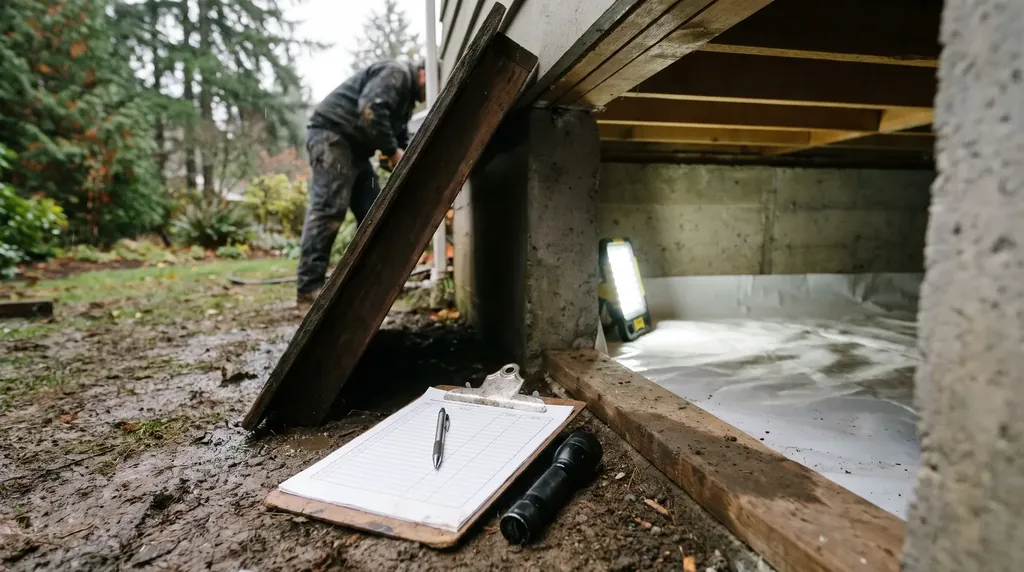
A crawl space note in a home inspection report describes a condition, not a verdict. Washington’s standards require a licensed inspector to go into the crawl space where it is readily and safely accessible, look for signs of flooding and moisture, probe wood where decay is suspected, and report all wood rot and conditions that invite pests. So expect the report to say something about what is down there.
Some of those notes point to a small fix. A few need a different specialist. Here is how to tell which is which, especially if you are a buyer or a seller with a closing date coming.
What a Washington home inspector looks at under the house
Beyond moisture, rot and pests, the inspector must report missing or inadequate vapor barriers over dirt floors, missing insulation between heated and unheated spaces, and uninsulated heating ducts and supply pipes in unheated spaces. They are not required to work out the R-value of floor insulation. They are also not required to enter a crawl space with an opening smaller than 18 by 24 inches, or with less than 18 inches of headroom below the joists or 12 inches below the beams. If your report says the crawl space was not entered, nobody has looked yet.
Common crawl space notes and what they usually mean
“Vapor barrier missing, torn or inadequate”
This is the plastic ground cover over the soil. Bare soil gives off moisture, and DOE says a crawl space must always have a ground cover that stops ground moisture evaporating into it. It can be a small, contained fix: the old sheet comes out, a new one goes down lapped and sealed. It does not, on its own, mean the house needs full encapsulation. See crawl space vapor barriers.
Washington’s residential code asks for at least 6-mil black polyethylene “or approved equal”, overlapped 6 inches at the joints and run to the foundation wall.
“Standing water” or “evidence of moisture”
This one needs the most thought, because the fix depends entirely on where the water comes from. EPA’s list of sources is plumbing leaks, gutters and ground that does not slope away from the house. Sometimes the answer is a downspout extension carried away from the foundation. Sometimes it is a plumbing repair. Where there is a history of water and no working perimeter drain, DOE’s guidance is that a drainage system is needed. Ask for the source to be found before you accept a quote for anything else. See French drains and foundation drainage.
“Insulation damp, sagging or fallen”
Washington’s energy code expects floor insulation over a crawl space to stay in permanent contact with the underside of the floor. Insulation that has dropped onto the soil is not doing its job, and if it is wet, the moisture comes first: DOE’s guide says moisture problems must be taken care of before insulating. Whether wet or soiled insulation can stay or has to come out is decided case by case. See crawl space cleaning and crawl space insulation.
“Wood rot” or “high moisture in framing”
Decay fungi need free water in the wood, above about 20 to 25 percent moisture content, to survive. So rot is a sign that wood has stayed wet, and the moisture source is part of the fix. Replacing damaged joists, beams or sill plates is structural repair. That belongs to a structural engineer or a qualified contractor, and we will tell you so.
“Pest-conducive conditions” or “rodent activity”
Inspectors must refer suspected insect problems to a licensed structural pest inspector or pest control operator, and cannot name a wood-destroying insect unless they hold that license. Rodents still living under the house are a job for a pest control company first. Droppings need care: in Washington, deer mice carry hantavirus, and people are usually infected by breathing dust from disturbed droppings or nests. The Department of Health says not to vacuum or sweep them. Once the pests are gone, soiled material can be cleaned out and gaps larger than 1/4 inch sealed.
“Ventilation” notes
A vent note may mention vents that are blocked, missing or covered. A vented crawl space is not a problem in itself: a small Washington State University study of new homes found that with proper site water management, vented crawl spaces can work in the Northwest. EPA’s Indoor airPLUS program exempts marine climates from its sealed crawl space recommendation. The fix may be as simple as clearing or screening the vents, not sealing the crawl space. Notes about the access hatch matter too: Washington’s energy code requires a hatch from inside the house to be insulated and weatherstripped.
A note about mold
If the report mentions mold or “microbial growth”, keep it in proportion. EPA says the key to mold control is moisture control, and that mold may cause allergic reactions in sensitive people. Cleaning mold off framing is a job for a mold remediation company. Fixing the moisture that let it grow is ours.
If you are buying or selling right now
If the inspector took photos, get them. They tell a crawl space contractor far more than the summary line does. Ask for any quote to be scoped to the specific notes in the report, so you can compare a vapor barrier replacement with a vapor barrier replacement, not with a full encapsulation package. If the inspector could not enter the crawl space, arrange for someone who can before you decide anything.
A crawl space note is not, on its own, a reason to walk away. It is a list of things to price.
Crawl space inspection questions people ask
What are home inspectors not allowed to do?
In Washington, an inspector may not name a specific wood-destroying insect unless they hold a structural pest inspector license, and must refer suspected insect problems on. They are not required to enter very tight crawl spaces or to determine the R-value of floor insulation.
How often should you check your crawlspace?
A good habit is a look in early fall and again after the wettest months. Under NOAA's 1991 to 2020 normals, about half of the yearly precipitation at Bellingham International Airport falls from October through January. Look again after any plumbing leak.
Does homeowners insurance cover crawl space repair?
It depends on your policy and the cause. Washington's Insurance Commissioner says a homeowner policy will not cover flooding and that coverage varies widely, so read your own policy. Seepage through a foundation is often treated as a maintenance issue.
How much does it cost to encapsulate a 2000 square foot crawl space?
Size is only one factor. Access and headroom, existing water problems, old material that has to come out first, and what the code asks for when a vented crawl space is sealed all move the price. Our encapsulation cost guide explains each one.
Got a report in front of you?
Send us the crawl space section and the photos. We will go through it with you, line by line.
- Call(360) 555-0163
- Emailoffice@bellinghamcrawlspacepros.com
- HoursMon to Fri, 8am to 5pm.
Thanks, we have your request
We will be in touch to book a time to look under the house. If it cannot wait, call (360) 555-0163.
Online requests are not switched on yet
Nothing was sent. Please call (360) 555-0163 and we will set up your free inspection.